Showing posts with label gear review. Show all posts

Sunday, September 26, 2010

New Shiny Thing: Nathans HPL 020 running vest

I have been looking at Nathans HPL hydration running vest for quite some time but never saw the need with all the other options I had at hand. It finally came to pass that I had to replace a pack and I jumped on the chance to finally fulfill my want. 

Made by runners for runners this is a very light pack made to feel natural on your body. The bulk of the material is a soft mesh liner that allows air flow to and from your body. The front is a very short vest that reaches just below the pectoral muscles. Aside from the vest flaps which hold the pockets the vest has a chest strap with fastek connectors. The left side connector, the female end, also has a built in clip to hold the hydration hose. Two loops, one on each shoulder, round out the decorations on the vest. It is mostly for holding the drinking tube in place but you can be surprised at what else could be attached here. 

The vest has three pockets; on the right side is a mesh pocket with a drawstring with cord lock. It can hold between 3-5 gel packs depending on your brand. It could also hold anything else of approximate size like food or  hard items as a SPOT gps messenger or camera.The left side has a zippered nylon pocket with a mesh pocket on the outside. The zippered pocket is for securing more sensitive items. I have used mine to hold my iPhone to play the Oo Tunes or Endurance Planet podcasts while running. The mesh pocket on the outside of the zippered pocket has no securing so I have not used it for anything other than used gel packages or something light I could safety pin or dummy cord through the mesh. I may in the future add a velcro tab or my own drawstring with cord lock. The positioning of the pockets is low on vest and occassionally my arm would run it as I moved but it never impaired my form or felt uncomfortable. 

The rear pack made of nylon is designed for the hydration bladder and minimal gear storage. It has a main zippered compartment for the bladder, a smaller zippered gear pocket on top and marginal but effective stretch cord to hold a light rain shell or hat. There is no outside stash pockets as this is the function of the vest in front. 


Utilitarian in design, the gear pocket that is on top of the pack is quite small, with enough room for only items like energy bars, sunglasses, gloves, extra socks, a beanie or those small necessity's any runner might need such as chap-stick, TP, cash or sunscreen.There is a inner mesh pocket to hold the smallest items and a plastic d-ring for keys.

The main pack is big enough for the 2 liter hydration bladder. It is made of very light material and reviews online have discussed this can leak. I have not had this problem thus far. The top is a fold over flap that you slide a plastic clip over. I have seen this on my my other drinking systems and prefer it to screw caps. Everyone has an opinion on bite valves, mine is that this is as good as any and I actually drank better from this than other so called, 'big flow' valves.  At the top of the main bag is loop to hang the reservoir from so it doesn't collapse to the bottom of the bag as it empties. When the bladder is filled with 2 liter of water I have only been able to fit a long sleeve technical shirt in the same compartment. 

Nathans touts this item having a 3 Way Propulsion system. This is a fancy way of saying the pack doesn't bounce around on your back. On the bottom of the main pack is a plastic tab. The side straps that control how tight you wear the vest weave through this tab. After a short run with the vest cinched tight like a backpack I had the dreaded runners-rub-rash under my armpits.  After loosening the straps I no longer had this happen and while I felt like the vest was too loose to my liking, it actually feels better to wear and there was still no bounce in the pack.  So the system does as designed as far as I could tell. 

At $85, cheaper if you look online, this is not an item you buy on impulse. If however you are a runner and you use a pack to hold water, I strongly advise you to try one on before you buy something else made for mountain biking or intended to hold more than 2 liters of water. At less than 6oz empty a runner will be hard pressed to find anything lighter or more comfortable for the road or trail. 

Wednesday, May 5, 2010

New Shiny Thing: LaFuma Cinetik 11 Pro backpack

In June I am heading back to the Grand Canyon for another trip below the rim with my company. When we went in October 2009, I took a great pack, but it had too much volume for a day trip, even packing extra for inexperienced people in my group. This time I am packing only for myself but the Grand Canyon in summer demands a size pack that I really don't have in my (substantial) array of gear.

Who am I kidding, I wanted a new pack anyway.

My demands on a new pack were not going to make my decision easy. Here is my list of what I was looking for. 
  • Hydration sleeve and external bottle holders. 
  • It must have or be able to except front pouches along the hip belt for food and small gear.
  • It must have the ability to lash trekking poles.
  • Hold between 300 and 1000 cubic inches of space for gear. 
  • A high attachment for D-ring, low attachment for rear light.
I could not believe my luck when I stumbled upon the Lafuma Cintek 11 Pro. First the weight is just over one pound.  At approximately 700 cubic inches of space it hits my sweet spot for the size to volume ratio I demanded. A bonus is that the hip belt is not a buckle that I tend to brake easily, it's velcro which also solves dangling strap tails. 

INITIAL IMPRESSION
The pack arrived within the set delivery time. I bought it used-mint condition and it was absolutely in great shape. I could not tell you how this was used.  The color is shockingly orange. It is at a level between hunter orange and florescent orange. I could see it as a detraction from those looking for a more matte color, but I like orange. I can't be upset LaFuma took it up a notch.


Along the otherwise clean and uncluttered exterior are two cinch cords for trek poles.  I took my poles and after a few different configurations found a set up that worked for me. No problem with this set up. A lower tab which the company suggests be used as a tow strap in Adventure Racing I attached a red LED for hiking and training when its dark out. There is a small zippered pouch towards the top of the bag face that has a very small loop on the bottom seam. 

Along the right side hip belt is a medium sized exterior pocket. A downfall of most hip pouches is that they flap around or slide towards the front. LaFuma has taken this pouch and stuck velcro on the back so it sticks to the hip belt. On the opposite side of the pack, the left hip belt is all zippered pouch. Its a flat fit, that upon trail and error can hold five gel packets.

Not only does it have an external hydration pocket accessed through the back panel, it has an internal sleeve as well. I can carry two reservoirs if need be which is a big plus when you live and train in the desert.   The hip belt is an interesting concept, instead of mating a male and female clip and pulling the excess straps back toward the pack; it is a strap on the right side, that passes through a swivel on the left belt and then folds back on itself by velcro. The excess strap is stuck to the belt by velcro.

It has four, yes four, pockets for water bottles. Two are located in the usual  place, lower outside, next to the hip belt. And for adventure racers and ultra marathoners there is a pouch built into each shoulder strap than can be folded flat when not in use. I love this option. The benefit of a bladder and bottles is that you can have water in your pack but mix carbohydrate and electrolyte powders in the bottles. 

FIELD TEST NOTES.
I have used the pack several times now for running and hiking. The first time using it, a 15 mile run, the dye in the padding (a maroon color) bled all over my favorite white hiking shirt. To overcome any future color bleeding, I placed the pack in a mesh ditty bag and washed on delicate in a front loader on warm water. Twice. Each time hanging it to dry. I have not had a problem since. By the way, I used various RIT products to restore the shirt from pink spots. The velcro hip belt keeps the pack snug against the pack and there was no bouncing of any type. Nothing chaffed my neck, shoulders, arm pit area.

The bottle holders on the shoulder straps do not accept standard water bottles of 20oz or 24oz. This is completely unrealistic in a real world scenario and unfortunate as they way the pocket is designed it could easily be made large enough to fit a normal bottle. I found a smaller 16oz. bottle in my cabinet, a cheap promo bottle from somewhere and it fit perfectly but I can't find  another. To overcome this challenge I bought to 15.2oz wide mouth juice bottles at a gas station, drilled a hole in the tops and stuck a hard straw in it from some 44oz drink cup I had laying around.

I was concerned about wear and tear on the Cinetik. I think I have done enough to it to state that this was a unwarranted worry. The zippers, pull cords, velcro and fabric have held up very well. I look forward to putting this pack through many more adventures.

Wednesday, April 21, 2010

New Shiny Thing: SPOT Satellite GPS Messenger (aka SPOT 2)

Why in the age of smart phones with navigation applications and precisely tuned dedicated GPS units that track your position to within a few feet, does one need what in essence is a satellite pager?  The same person who can't get cell phone coverage outside of city limits and owns a top of the line GPS that can only tell you exactly where your at when you need emergency assistance.  This is the territory that SPOT is trying to own. 

SPOT has received a bad name in its short life because it isn't a phone and it isn't a GPS and it isn't a personal locator beacon. But it does contact who you want, it does track where you are at (more on that in a minute) and it can notify people if you are in an emergency situation. So lets take a closer look.

First, why does SPOT have a bad name. Well SPOT is first and foremost marketed as a messenger tool with the ability to assist you in the event of an emergency. The company at first, and possible still try's to come off as an satellite emergency notifier but the provided manuals give this area equal space to the more mundane aspects of the unit. The vast majority of the market share SPOT is trying to navigate is controlled by companies selling units called PLB (Personal Locator Beacon). These dedicated units require no subscription after purchase like SPOT does thus the mud racking. Plus PLB's are the less is more item.. A one shot life saver. Press the emergency button and a distress signal is transmitted on a frequency dedicated to search and rescue teams in your area, which will come to your aid. While SPOT has more more communicative options.

After buying a SPOT unit, made and operated by GlobalStar, Inc,  the user must activate the unit with an annual subscription for basic service with additional payment options for improved benefits. PLB purist scoff at this notion claiming that a for profit company using its own satellites is not as effective as  using the internationally recognized rescue satellites used by all other land and marine based responders.  However, SPOT provides a lot more service than just a one use "Rescue Me, I'm here" button and to date SPOT has saved thousands of subscribers using its system. I have no problem with paying a for profit company for its business as long as it delivers.

The unit is the size and width of a hamburger patty with a solid face with  of mostly circular design with deep set buttons along the bottom third. When turned on the unit sips power off lithium battery's.  Unless told to perform a task it merely blinks green that the unit is on with a estimated standby time of three months. When tasked with a job the GPS light will blink green that it is attempting to find a satellite and then blink when it is sending the message. All errors show with a red blinking light. After it has completed its task it will continue to show the user that it did or did not send the message for up to an hour. This means the owner doesn't have to stare at the unit for twenty minutes waiting for a message to go out, but can look at it later to see the results.

COMMUNICATION.
I spend a lot of time in areas outside city limits like canyons, mountains, deserts and waterways, ergo I spend a lot of time outside of cell phone range. It's important to my wife that she knows I am okay. And it gives me piece of mind as well that she is not concerned about my welfare. SPOT allows you to press a button whenever you want and it transmits one way messages to anyone placed on a online contact list. This is set up using your account profile pages before you go off the grid and can be changed as often as you want depending on your needs. You can send what I call 'pings' to cell phones receiving text and anyone's email. When using the Check In button on the unit, it sends the name of your unit, your location in Latitude and Longitude and a preset message, "I'm Okay". 

If you use the Custom Message button, you can change the verbiage, again using your online profile, to suit the needs of the trip. One day it could say, "At the top of the mountain, heading back to trail head" the next, "Found the last geocache, heading home."  It also sends the name of the unit and location in lat/long. My wife is the primary recipient of my custom messages which say something like , "Finished with workout, coming home, will call when I get in range".

In today's age of instant email and lightening text, SPOT is hit and miss on connection. Granted your using satellites and not cell phone towers and T1 lines. Using a stopwatch and my cell phone as a contact, I would activated the Check In function and measured how long it would take from pressing the button till the message hit my phone. I did the same with the Custom Message. The best time has been 90 seconds. The longest 17 minutes. However, every time either button was activated the message was received. The unit will make 3 attempts over 20 minutes to send a message, (the person receiving only gets one 'ping') so even at the longest time, it is within the company time line.

GPS
SPOT units track your whereabouts but the user can not see the coordinates because there is no data screen.  However, as mentioned before using the basic communication buttons a trail of digital bread crumbs is created with outgoing messages. For an additional annual subscription fee a tracking program is provided on the unit that when activated by its button on the unit, will transmit your location every ten minutes for 24 hours or the unit is turned off. These are not sent to individual cell phones and emails but to either your online account or pre-created SPOT Adventure Shared page. If you create an Adventure page for your event, you are given the URL link for that specific event and you then send it to whomever you want or even social media websites. It will update the Shared page with your current position and update the previous two positions in case the 'ping' did not get out. The map is a Google Map model with the usual map viewing options. This is a very cool tool and well worth the investment. There is no need to download data from a GPS to your computer and then software the route to send to friends. You can also come back later and upload photos from your trip and if your digital cameras internal clock is accurate the program will automatically link photos to where you were on the trip. 

Coming from a dedicated GPS world it does take a few Adventures to adjust your viewing paradigm. With a dedicated GPS, it tracks your every foot and zigzag of movement. The SPOT only sends a 'ping' every ten minutes. When seeing this, you have to adjust to that fact even though you just did ten switchbacks, the tracking function will be a straight line from point to point. Its a as-the-crow-fly's mentality. The map will also show the location of any one way message you send. Those people will only get the messages and not a track every ten minutes. 

Your subscription saves all 'pings' and tracking for thirty days. If you do not set up an Adventure page before you head out,  you can do it when you get back. By selecting the dates you want to use for your adventure, the page will automatically export all your tracks that are in that range of dates to a map.

PLB
No one wants to be in a situation that demands rescue. The fear and panic is only elevated when you are in the middle of nowhere, miles from civilization. SPOT is not a classic personal locator beacon, nor do I suggest you purchase one for such a need if that is your only concern.  SPOT has two covered buttons  on the unit, Help and SOS. These are set along the outside edge of the face at 3 o'clock and 9 o'clock. To activate you have to pry the cover off with your fingernail. This is also a point of contention with PLB purists as it's believed that a rescue unit should be able to be activated with one hand.  Its a fair point.

Help, on the left side, sends a message to your set up contacts, again with your unit name and location and a custom message. If you purchase additional services, there are options for road side service and marine assistance. SOS is on the right side of the unit. Pressing SOS will activate a 'ping' every 5 minutes for 24 hours. This message takes outgoing priority on GlobalStar satellites. The message is sent to their emergency center and they arrange communication with the nearest Search and Rescue or1st Responder  unit to your location. An additional service that can be purchased is GEOS Rescue Insurance which provides up to $100,000 for your rescue efforts.

SUMMARY
Filling a niche that continues to become mainstream with each passing month, SPOT is a unit that first and foremost guarantees successful one way communication between user and contacts. This not only brings piece of mind but draws friends and family into your life using your Shared Adventures pages. There is a big difference between needing a rescue because your stuck along the freeway with no more inner tubes for your road bike and having a broken ankle ten miles from your car.  In the rare event that outside assistance is needed to effect your safe or timely return, Help and SOS are there for you to dictate your level of assistance.

Here at Endurance Pursuits, I guarantee I will be using SPOT weekly for my training that occurs in and around the Superstition Mountains. My training area a 30 minutes drive from cell service and my wife as soon as possible wants to know I am safe, in my car and heading down the mountain to come home. As an endurance athlete living in the desert, I feel I am doing my family and friends a service by taking steps to protect myself. 

I am not going to just exist. I am going to live.

Tuesday, April 20, 2010

New Shiny Thing: RailRider's Eco-Mesh shirt.

I started following Adventure Races like Raid Gauloise and its more successful sequel Eco-Challenge when they began showing in the very early 1990s.  I still follow Adventure Races quite closely.  RailRider's Eco-Mesh shirt was born from the need to provide adequate clothing for these multi-discipline athletes. This shirt continues to have a strong niche with ultra  athletes at events like Badwater 135 and Marathon de Sable  as well as worn by thru hikers on American trails. 

I don't have Adventure Racing on my short list, but I do share a love for training like one.  I also appreciate gear and clothing that has multiple uses. My final impetus to finally buy one was my desire to have a shirt that better dissipated my body heat, thus staving off overheating, dehydration and heat injury. Hey anything that helps me in that department is good.

I bought the shirt in white and was shocked at how brilliant and blinding white the top is.  I have zero luck keeping white clothes stain free but I surmise my main problem will be trail grime and not pasta sauce. Though I think I could pull this shirt off in a lot of nice eateries.

I purchased the shirt from the manufactures website. The shipping and handling were more expensive than the few other sites that sold the garment, even at lower prices, but I chose a decade of drooling on their website as a reason to go to the source.  My loyalty did not disappoint, I received the shirt in two days with their cheapest shipping rate. Much earlier than anticipated. Which gave me an opportunity to try it on the next day for a seven mile recovery run in the Superstition Mountain range. 


Weighing about the same as a short sleeve cotton shirt, this long sleeve 2-ply nylon top dries infinitely faster. The material up the side and down to the cuff is two inch wide mesh that offers terrific ventilation. There is also a thick ribbon along the upper back covered by a yoke of material. The cut is quite generous, more like wearing a pajama top than a tee shirt. It is incredibly breathable. It also has a SPF 30 rating.

The Eco-Mesh shirt has elastic cuffs that are not so tight that you can't hike the sleeves up to the elbow and they stay there. The elastic will also keep out flies, mosquitoes and ticks if need be.  To keep weight down there is no collar and the v-neck can be closed by a Velcro tab. Inside the shirt is a fastener to keep the tab secure when the collar is left open.

I wore the shirt with sleeves up and sleeves down. Each was comfortable and the elastic kept the sleeve from sliding down my forearm. The cut and venting allows air to circulate very well and I don't believe I was sweating any more than I would with a sleeveless technical shirt. The benefit of the shirt here is that without having to apply sunscreen to my  bare skin, it breathes easier and evaporates sweat more efficiently.

I also wore a Camelbak MULE and when I was done the shirt back was quite sweaty. I was surprised that it dried so fast, just a few minutes after getting in my vehicle to drive home.  I was conscious of this fact mostly from the thousands of times I have finished a workout, got in my vehicle and my back has remained wet and clammy till I got home a half hour later.

This is not an item I will be wearing in regular rotation for running on the streets but I see a long future in casual summer wear and I hope it becomes my permanent trail top for hiking and desert runs.  I have had the same make/model hiking shirt for almost ten years and the only way it will be knocked from its pole position in my closet is by the Eco-Mesh continuing to impress me with its quick drying, ventilation ability. 

After ten years of reading fan mail from satisfied customers and my results after a hot, desert run, I predict a changing of the guard in the very near future.

Sunday, January 17, 2010

Shiny Things at work

While many find that driving today could not exist without TomTom, Nuvi or other dedicated automotive GPS system, I don't own one. Shock. However, on my last road trip of approximately 300 miles round trip, I was pleasantly surprised by what I do have.

First, I used my iPhone. I suppose any phone with an "I'm right here" map program is good, but I do like the map program that comes standard with the phone. The national park I was driving too, did not have a physical address, so I just plugged in the city, state and figured on using road signs for the rest. As I drove, the app showed me in Google map mode where I was on the road. Whenever I wanted to know how far I was from my destination I back up a page to reload the distance from my current location. Very cool.

Normally the iPhone app would lead me right to my destination, but I did not have a physical address. I did have GPS coordinates and my DeLorme PN-40 GPS. While playing around with it, I found I could plug in coordinates and give myself a driving route, rather than a foot based plotting. The latitude and longitude took me to the entrance of the park and then it beeped. Shocked the heck out of me. Then it beeped again. I will be using this feature more in the future.

I do believe that having a just for the are GPS would be a great peice of technology. Especially if you can search for businesses on it. Luckily I have an app called 'AroundMe' for my iPhone which helped with a tricky piece of business on this trip.

Normally for long trips, I pull out the portable DVD for Mighty Mo. He doesn't need it much but its a handy diversion. I loaned it out and got it back the morning of the trip uncharged which created the obvious problem of no movie distraction. On the way down this was not a problem for Mighty Mo he played with his Star Wars figures the entire time.

Coming back I decided to fix this problem and provide Mighty Mo with a working player. I know that Kinkos sells a converter from car power outlet to 120v plug. As I had the wall charger for the player if I could find a Kinkos and they had the unit, Mighty Mo would have a movie. The app took me right there. No way I would have found the store without it. And the converter makes a great new addition to the travel kit.

So, lets summarize. While car specific GPS systems are great, a smartphone system like the iPhone will work with little extra effort. Especially if you have a business searching app like the one I mentioned. There may be better, I don't know. AroundMe is free at the iTunes store. Next, if you have even an older GPS with updated road software, it is just as possible to drive yourself someplace as walk. Though be careful as your unit may not convert to driving and the directions you get will not take primary roads.

In this economy it is best to use what you have in a better way, rather than buy new stuff....yeah I don't believe that either, but it sounded good. As always you will get your monies worth out of the things your use.

It's not enough to exist. I am going to live.


Wednesday, November 18, 2009

A New Shiny Thing: Mountainsmith DAY lumbar pack


For those that know me, they know I am seldom parted from my backpack full of wonderful shiny things. Today I discuss my newest shiny thing, the pack itself. Its a Mountainsmith Day lumbar pack

My first impression of the pack, in Red, is that it is made to take the worst sort of beatings and last for years. The reviews from customers said as much, but seeing is believing. The YYK zippers are quite sturdy on its three pockets. The first pocket modest sized for quickly needed items. The main pouch zipper is close to the top of the pack and holds the bulk of the storage space. A very small zippered internal pocket for keys, wallets and such is inside this larger area. Along the rear of the pack is a thick back pad. There is a hidden unzippered pocket behind this for paperwork or passports. On the bottom of the bag and along the hip belt are cinching straps to even out the weight being carried.

There are four ways to carry the Day. First is the classic fanny pack mode, using the hip belt When not in use, these can be tucked out of the way quite securely behind the back pad. Next, by using the two top bag loops much like a gym bag. The last way the bag can be carried out of the box is by the provided shoulder strap which attaches to the Day by use of two quick release buckles. Mountainsmith has an aftermarket product called Strappettes, which I did purchase. The Strappette is a harness that replaces the shoulder strap and allows the Day to be worn like a backpack.

My one concern was the external bottle holders. I saw a smaller version of the Day, called the Tour while at REI. A standard 1 liter Nalgene bottle sticks out from the top of the pocket an inch or more. This gave me pause to its ability to keep the bottles seated when doing those things that I do. I think these would be just securing tall bike bottles or 1 liter Gatorades that slope inward at the top. When the Day arrived the first thing I did was load two full Nalgene's and the fit is perfect.

I would have to wait a couple weeks before I could hit the trail with the Day, but I moved out of my backpack as soon as it arrived. Using the carry strap, I have had the bag with me daily for work and it holds everything I need, including lunch. On the weekends I have loaded up my DSLR camera, extra odds and ends for the kids and its done very well. I appreciate that the entire profile of the bag is smaller than a standard backpack. It fits under seats and strollers much easier.

When the shoulder strap is removed the Strapette harness attaches to the same quick release buckles on top of the pack but require some visual cues from the instructions to attach to the hip belt on the front. Based on just weight bearing, I don't think a set of quick release buckles on the hip belt would be out of line to make this process easier. However the harness is a great addition, dare I say required for trail use.

I used the Day pack with Strappettes for my Four Peaks summit hike. I carried my standard light hiking kit, added my medical kit, GPS, plus a down jacket. Add some food, two full Nalgene bottles and an extra liter in the pack and total pack weight was a tick under eleven pounds. Using the Strappettes and the pack being located along my hips, I barely noticed the pack on me at all. I felt much lighter than if I had the same gear in a backpack. Much of this hike was done in a steep scree chute and I dragged the pack along sharp rocks and rough ground. The pack was scuffed and dirty but not a tear or fray. The same can't be said for my trail buddies pants.

Ultimately I will test this pack on a multiday backpack trip, though not as the primary pack. Instead, using the Strappettes I will attach the Day so it sits in front so I can access food, water, maps, camera, rain gear and bug dope without having to take off my full pack. When a campsite is established, the Day will stay on me when I am outside my tent, holding immediate need items which will also include fishing tackle.

Monday, September 21, 2009

A New Shiny Thing: Platypus Big Zip SL

It may be premature but after one week and several uses I am totally in love with my new Shiny Thing. The Platypus Big Zip SL, a 100 ounce hydration reservoir.

Don't ask me how because I can't pinpoint it but I recently popped an 'unbreakable' Camelbak 70 ounce reservoir. I really like Camelbak gear. They are a quality company but I have an open mind to replacing gear so I went to my local REI and looked around. After my contact there laughed at me, in his experience I break more unbreakable gear than any person he talks to, we moseyed over to the hydration area. In my everyday backpack I have a 2 liter Platy Bottle that I have been very happy with for a couple years so looked for their model comparable to my punctured Camelbak. This is where I found the Big Zip. Plus its made in Seattle and I have mad props for outdoor gear made in my hometown.

My New Shiny Thing weighs one third as much as what it is replacing. I really like the fact that it is clear plastic with a special film inside that is antimicrobial and anti-slime. It has a secured carry handle that covers the large ziplock top. With the opening at the very top it is easier to clean and easier to fold and package into my more narrow packs which is not as easy when their is a large rigid screw top lid on the face of the unit, ala Camelbak.

A great addition is a quick disconnect for the drinking tube. I have run into drinking tube issues in the field and the ability to take the tube off and not have the reservoir at risk of spilling is a real benefit. Plus for packing the unit away the tube can be removed from the reservoir without concern that the constant on/off will stretch the tube at the connector causing leaks. Again an issue I have come across.

For anyone looking for a replacement reservoir or a second one to carry with you, I highly recommend a look at the Platypus Big Zip. If your daypack has a sleeve to fit a hydration reservoir do yourself a favor and start packing your own water. At $32 you will easily recoup your costs in no purchasing bottled water. Even if you just fill up at the twenty-five cents a gallon refill stations you save in some cases 75% on water costs over buying one liter of bottled water at the store.

You have lots of options for carrying water with you. Nalgene bottles, stainless steel bottles, reused water bottles, bike and running bottles. Hydration systems. All have their time and place. The important thing is that you are drinking water or other beneficial fluids throughout the day. And you bring enough with you. Whatever water you think you need to drink at that time, double it.

There's treasure everywhere.

Wednesday, June 25, 2008

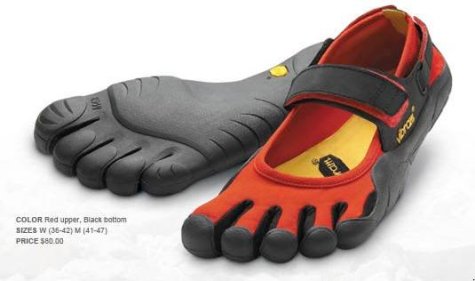
A New Shiny Thing: Vibram Five Finger Shoes

I fell in love with Vibram in the Army. It is a company that makes soles for combat boots. If you have never been in the military or worn those types of boots they are also very common in civilian application for hiking boots and multi-use shoes. They are very well known for comfort and shock absorption.

Vibram now has its own 'shoe' called the Five Finger. Time Magazine called it one of the best inventions of 2007.

Look pretty weird, huh? Its essentially a glove for the feet with the soles laser cut so that there is the full and natural movement of a bare foot. They fit like a second skin and the bottoms have a very tactile, sticky feel to them.

The primary applications are for kayaking, boating, yoga, instances where bare feet are natural. It has been 'co-opted' by barefoot runners who need just a little bit more than zero protection. If this shoe actually catches on with the public, the Nike Free will drop off the face of the earth by the end of the year.

There are four versions. The Classic is a model without a strap over the foot. This first model was made for yoga and boating situations. When feedback came in that people where using them outdoors they felt like they would slip off when crossing streams so the Flow and KSO (Keep Stuff Out) models came on line. I purchased the Sprint which works for all the above applications plus appeals to runners. Only color available to me was Pearl and Orange which is fine by me but really wanted the Olive Drab military looking version. The Red version below is a bit boisterous for me. Screams, athletes foot.

I got them because I enjoy being barefoot but have tender feet. Walking outside barefoot is really not something I can do without pain. I own slippers and crocs and sandals but I think shower shoes are a terribly gross fashion statement outside the house and crocs can be really hot in the summer. Also none of those are very secure to the foot and I like to know that if I have to run or react quickly I can do so without losing my footwear. My intended purpose is to use them around pre/post endurance training and races; to & from swim workouts, before and after my rides and runs. I will also use them in the gym; the natural movement of the shoe will allow me to recruit more bio-mechanical feedback into my functional training. Of course use around the house is a foregone conclusion.

Because the shoe is not heel heavy, the wearer will walk naturally, therefore run naturally on the ball or mid foot right out of the box. For those people trying to overcome a heel strike or longer stride, this shoe would fit right in to the training regime. I think Chi or Pose runners will enjoy these the most. As someone who last year finally overcame his heel strike running style, I can say that I am a better runner now by far.

I spoke with someone who wore them for two days going through the Air and Space Museum in DC and loved them. However they are not meant to be a fully functional shoe for being on your feet all day and your body will need to adjust to them. To begin most toes are not be used to being individually sleeved and separated compared to the mitten like sock. The ankles and calves will take time to adjust to a new structural environments because the rigidity is missing but the all out force is not.

They're pretty goofy looking too. I have worn them out and get constant feedback on them. People ask if they can take pictures. Driving feels like its done barefoot. Climbing stairs is a much more tactile sensation. I can feel every rock or edge that would have had me yelping or acting like I was walking on eggs but don't suffer any of the slowness or pain I did before.

My advice is that if you are looking for a camp shoe, boating shoe, house shoe, part time exercise shoe and want to eschew the common running shoe or the trashy flip flop, try to find these. Go online first. They run in European sizes and from my experience and research they run a size lower than normal shoe wear. If you have a longer second toe (mutant) and seriously interested in trying them, some forums will have feedback on that 'condition' (mutant).

Have Fun.

Wednesday, May 21, 2008

A New Shiny Thing: Stove

Oops I did it again. Can't help myself. I bought a new Shiny Thing. I have been listening to my Godfather discuss his plans for what was to be OUR backpacking trip this August. But due to my current condition that is not going to happen. Damn it!

My new Shiny Thing is a REAL. SHINY. THING. It is an alcohol stove for backpacking. Here is the official ebay site. It uses denatured alcohol not gentleman's booze.

I have been trying to find ways to cut down gear weight and work towards a greener posture at the same time. The stove weighs one ounce and is made from a recycled energy drink can.

I am not a gourmet chef in the bush, crap I can't even cook in the house, so mostly I just heat water for drinking and heating up meals. There is no such thing as saute or simmer in my repertoire.

The stove has holes drilled 3/4" from the top all the way around. The fuel goes in the body but when a pot is placed on top it creates pressure which forces the flame through the side holes in a manner not unlike a blowtorch. A wind screen is necessary to protect the flame from the elements but also heats the pot faster by reflecting heat. Its recommended to use a wide bottomed pot or even a tea kettle based on the way the jets distribute the flame and provide balance.

The fuel, denatured alcohol, is very inexpensive and common to find. Alcohol burns extremely clean compared to propane/butane mixed one use fuel cans or what white gas puts out, the most common types of camping fuel. To save additional weight I will most likely carry my fuel in a recycled 20 oz soda bottle.

FEILD TESTING.
Field testing took place over several nights in my backyard with my co-pilot Mighty Mo. Each test used two ounces of alcohol. I used an older six inch wide camp pot with no lid. The first test it took over a minute for the flame to ignite the fuel and prime the jets. After that I wrapped a fiberglass candle wick around the body and add a bit of fuel to the wick when I fill the body. By lighting the wick and not the fuel in the body it warms up the fuel faster, thereby igniting the vapor faster. This dropped the priming time to about twenty seconds and saves a lot of fuel.

Without the lid I heat two cups of water in an average of 5.5 minutes. I have read that with a lid it can be done in three minutes. Makes a great cup of tea or morning cup of coffee (french press).

Weighed out I am saving at least one pound for every couple days I am in the field. I would recommend this as a gift for an outdoors friend or family member. It may never replace their established norms but outdoorsman like back ups and its a proven field tool.

A New Shiny Thing: helmet

Its the return of Shiny Thing segments. For the uninitiated, Shiny Things are usually very cool objects, though not necessarily shiny. (Though if you think about it most shiny things are pretty cool). They can be expensive or not. Shiny is a figurative frame for getting something you want or didn't want but you got it anyway because its cool to you.

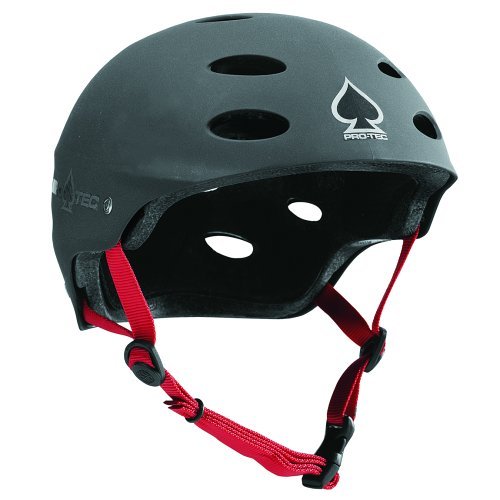
I finally found a helmet for "non-biking" activity. For those unfamiliar as to why I would need a helmet for activities other than cycling please click the 'TBI' link below and read up on my unusual life of head injury's. I chose the Pro Tec Ace Freestyle SXP.

I had certain demands when making my decision. It needed to obviously protect my head from the knocks that will give me yet another concussion. It needed to have a classic, multi use look as opposed to a specific shape like a helmet. Lastly, due to my location, it needed to be well ventilated.

Pro Tec has mass popularity in groups that demand head protection like skaters, BMX'ers and special operation military units. They are light weight, take a beating and depending on the model is quite well ventilated. When I worked in urban combat scenarios in the 1990's we used this type of helmet or a hockey helmet. Neither of them had any ballistic protection, but the opportunity for injury was greater from hitting or falling down something in a busted up building.

There are helmets on the market that are more and less expensive than Pro Tec models. The deciding factor for me on this particular helmet is two fold. First it is CPSC which means it is fully complaint as a cycling helmet. Second it uses a new technology inside called SXP, which allows for multi impacts without decrease in protection. I hope to never put this technology to the test but if I do, its nice to think that the helmet may be stronger than just a basic model.

Some other positive considerations; the helmet is molded for goggles. There are a dozen vent holes on the front, back and top which will help in desert climates. Each helmet fits a bit differently so I do suggest that if anyone is looking for a multi sport helmet they try several models. The 'water' models have a liner that allows the helmet to float and provide ear protection. Some models use an additional strap that attaches around the throat to provide additional connectivity to your head.

What will I use this helmet for? Good question. Right now watching tv and yard work. Just kidding. Actually I will use this for quite a lot. I sometimes pretend to water ski, each time I fall pretty hard. For Mexican vacations I like to use ATV's and a personal helmet is better piece of mind than a rental. Mistress would like to take me horseback riding at some point. I have a full suspension mountain bike and would rather use this helmet than my over priced tri-helmet. When I do desert runs, I have been known to boulder and having this in my pack would be a benefit. I am invited to 4-wheel a few times per year and there is the potential to hit the head when being rocked inside a vehicle. I owe Bolder a trip to his town and I am sure he will try to get me to snow ski if its next winter.

In the end, this will give both Mistress and I peace of mind and that is worth a lot. I don't mind the looks I may get looking out of place. But its worth it.

Thursday, May 15, 2008

Gear Review: Ironman Shock Watch

I was going through some boxes in my garage and found my Casio G-Shock watch that I bought in 1988. I wore it almost the entire time I was in the Army and beat the living hell out of it. The watch is twenty years old, been sitting in a box for over a decade and the battery is still running. I decided to go out and get another model.

I did a lot of research, all good shoppers do, and in the end I went with the new Timex Ironman Shock watch, their equivalent of the G-Shock. I am so happy Timex makes this watch. I like Timex over Casio because, well lets be honest it has about a half dozen M-Dots around the case. Because its a true dive watch (200m, thats down, not distance) the buttons and split button are a bright orange as well as the M-Dots.

However here are the reasons I think more of you should consider this watch for your next non-HR digital timepiece.

This watch has a very large face. I personally like large watches. The reason for the added size is that as a true dive watch it is pressured which means you can use it for diving down to 200m. Also the buttons are closed off so you can truly press splits/laps underwater which is a great asset in the pool.

Secondly, Timex has a great numbers font. If any of you have really looked at other digitals closely, there are some that have darker numbers but smaller, larger numbers but use a dot matrix. Timex numbers are decent size and clearly visible from literally an arms length.

Timex Ironmans are a vision of simplicity. When compared to similiar digital dive watches, like the Casio, there is all types of clutter on face. In fact this Timex Shock takes simplicity one step further in an awesome way. Using the mode function you can turn off options like multiple alarms, occasions and on this particular watch a Golf function. Of the many modes available I turned all of them off except Time, Stopwatch, Countdown and one Alarm.

If Timex did not invent the Indiglo it captured the market share. This new generation of watches does not light up the entire watch face with the blue backlighting but designed the watch so that only the numbers light up. It does take getting some used to but it give just as much light to see at night. Plus with the FLIX system you can flick your wrist towards you the Indiglo will automatically turn on for a few seconds.

For those of you looking for a new Timex Ironman I suggest looking at the Shock. It will take a beating, is completely waterproof and able to work buttons underwater. You can turn off modes you would not normally use. I got mine at Wal-Mart for about $60 which makes it cheaper than most normal Ironman models you would find at bike shops.

Thursday, December 20, 2007

PSA; Be Prepared

The news hounds have been talking about the dad and kids in California that got stuck in the woods for three days while trying to cut down a Christmas tree. Not too much it appears because every other word out of their mouth is humbly praising God and their faith carried them through. I am going to give you my thoughts on this survival story and then some tips for yourself at the end.

SHORT TANGENT: I think this hasn't got as much publicity as the Kim tragedy or the Mt. Hood tragedy because the news feels it okay report someone 'found' God in a foxhole, or use Him as a euphemism they just can't REALLY believe in religion or allow the name Jesus Christ used as a affirmation of His plan for your life.

But the point of this post is to mention the importance of the 6P's. Prior Planning Prevents Piss Poor Performance or a my platoon sergeant used to say to me, "Planning equals not getting killed, Mann."

First, the family did not tell anyone where they were going. "It was a nice day. They were just going to the woods to cut down a tree after church, they didn't know the weather would turn," you say? Look what happened. Things like this do happen and while it may seem foolish to tell people where your going all the time, its important to do so when you will be out of good communication or cell phone service.

Second, they had an ax/saw to cut the tree, but no matches or lighter. This really comes down to having just some basic thoughts about your environment. I have no illusions that most of us would carry a sleeping bag, some water, maybe a map and compass or a even a knife with us on a short trip to the woods. Even so the items would probably be left in the car. However, everyone understands that winter weather is unpredictable and can change rapidly. Carrying some basic survival gear takes up less than a jacket pocket. Just a simple fire would have increased their chances of being seen, improved their morale and kept them warm.

Staying on preparedness for a moment; be ready to spend a night outdoors, regardless of the time of day you leave and plan to return, every time you leave suburbia. Its easy to flag down a car on the side of a major freeway to change a tire, a bit more difficult if the main road is several miles away or the road is less traveled. Chances are 1/10 someone would stop anyway on a deserted road to help you.

Here are some tips I have for you and your next outing.
  • Leave a note or voice mail of where your going and the when will be back. This can be as easy as telling your spouse the route your running and how long it will take. In the winter if you slip on some ice and break a wrist or sprain your ankle you may not get back in time and they can come looking. For longer solo trips or overnight trip in a group, give a NLT (No Later Than) time. For example: tell someone where your hiking and will be back by 4pm. If they don't hear from you by 8pm to call the closest police. Personal Note: When I swim up at Canyon Lake there is no phone service, as I drive up I tell Mistress when I will be back down the mountain and I call her as soon as service is available.
  • Stand out without standing out. Its seems silly but you're not alone outdoors. If you do become lost it is probably on a path or in an area that people do frequent. So if SAR (Search And Rescue) is called to look for you its a good idea to give them some info to discern you from everybody else in the last week that has been where your at. For example: when you leave your car pull out a square of aluminum foil and step on it with your footwear, making an imprint of your sole. On the back, tape a piece of paper with your route or destination, the gear you have with you and what your going to do if you discover your lost; sit and wait or move to 'handrail', (like knowing that at any time if you walk east you will reach a stream). If SAR knows that your heading to Mt. Trundle, have a sleeping bag rated for the season, a means to make fire, cold weather clothing and a flashlight, they can create a better plan of finding you than searching an unknown grid. Personal Note: A friend of mine became lost on a mountain while out running. She had several pairs of the same shoe so I brought a pair to the SAR base camp with thoughts on her running routes. The were quickly able to find her shoe imprint leading off the main trail and found her by a stream with a broken foot, she needed to refill her bottle and slipped on moss. She would have been found eventually but was saved several hours earlier.
  • Be Prepared. I know it sounds incredibly cliche and you might feel weird, but a small backpack or fanny pack can sustain you for days in freezing weather if you have the right gear with you. I won't belabor the obvious so I will link to the 10 Essentials. Personal Note: While I am often maligned for my ubiquitous backpack, I have most of the 10 on me at all times, with redundancies in many cases plus a few extra tricks I learned on my own. My EDC (EveryDay Carry) fits into a small 3x5 pouch and goes every where with me. Maybe I put up some photos of my stuff for you to see.
Most of you will have started scrolling by now, so how about ending this on a positive note, Christmas. Here are some last minute fantastic Christmas presents for someone you love. A car emergency kit. A small personal survival kit, my personal favorite. What guy doesn't like a simple compass. A medical kit. Headlamp or flashlight (personal fav's). Go to your local big box like Wal-Mart or Target and make a nice emergency kit for someone with a cheap backpack include; flashlight, small blanket or inexpensive sleeping bag, a bright colored rain poncho, a single bladed knife, generic multi tool, cheap transistor radio, compass, a waterproof match case or waterproof matches. Lighter. Duct tape. Extra batteries.

By the time you're done you'll have a second set of everything for yourself.

Tuesday, October 2, 2007

Interbike 2007 report from the floor

My very good friend and advocate Kevin, is the owner of Tribe Multisport. His company is the largest triathlon store in the Phoenix metro area and as plainly obvious at any local triathlon, has a tremendous footprint in this incredible sport most of us enjoy. Not only does his crew uphold quality customer service that honestly puts most LBS to shame, Kevin genuinely is a man who cares about his customers and their level of experience in his store.

As many of you know, I would not think a trip to the valley is complete without introducing you to Kevin. And as especially Nytro and Benny have found, his generosity lasts past my presence or that singular event. Kevin and his crew truly make me proud to introduce them to new people. How many of you simply must introduce your out of town guests to your LBS crew? Exactly.

He is a fountain of information in the sport and innovative in his approach to business. Recently he took his entire staff to Interbike in Las Vegas and he wrote a message to many of his close friends relating his experience. I knew immediately it was gold and asked if I could post his message, which of course he gave full consent to do.

Please enjoy.

Howdy everybody,

With all of the Interbikes I have attended, it is getting increasingly difficult to get excited about it. When I was a kid, you go to the show and are blown away at the sheer magnitude of it all, being awed at each turn of every isle seeing one new thing after another. Then, you get older and it becomes quite routine; you know, the same bike lines with close to the same product with new splashes of paint and some slightly varied component specification. …and even worse, when you become a shop owner, you literally sign your life away. I go to the show with the responsibility of “forecasting” the year to come with pre-season orders. This includes all of the bike lines, some of the accessory lines, and all of your clothing lines.

This year was a little different. At first glance, the show seemed to be just another dog and pony show of last years stuff with new shiny paint. BUT WAIT!!! There was new stuff every where I was winding up. J!!!!! New wheels, new frames, new computers and heart rate monitors, and completely redesigned clothing lines. Below are some of the highlights that caught my eye.

BIKES:

For me, Argon 18 had the show stealer. Their new triathlon frame set is not only wicked cool looking, but functionally correct. It is the Element 114 and it is very obvious that they did their homework when it came to the finishing touches. They use M-series carbon throughout, proper internal cable routing, functional and beautiful integrated aero bars and fork with 6 cm of adjustability (!!!!!). Wind tunnel testing was off the hook for this guy too! They also have a version called the Element 112 with conventional cockpit for those needing a more affordable option.

Cervelo is staying the course with their resilient and proven P3C and P2C offerings. New paint and a new $2,500 option on the P2C. They have a new road frame that is quite a find… The RS: a race bike for the older athlete or distance road racer.

Felt is always good for good looking bikes. Their ability to “buy” market share is diminishing a bit, but they still offer some neat stuff. They have a Tri bike that is $9,500!!! Holy cow! It looks really cool, but 10K? Not for me, but thanks.

As for complete lines, I am most excited about Jamis, oddly enough. They are not really known for their “wow” factor, but they brought it in truck loads this year. They have a road line up that is to die for. The buzz about the show was, “did you see the wind tunnel results for the new Jamis?” You may want to sit down for this one: A wind tunnel test was conducted with almost all of the heavy hitters and specialty bikes and the Jamis Zenith T bikes TOPPED the list. There will be a line for these. J Good thing I sell ‘em.

Kuota is always strong and their booth is always packed. I am their number one dealer in Arizona, number 4 in the western half, and number 12 in the world and I even had to wait for them to create a free moment to walk me through line. Their road bikes are always amazing, and their tri bikes are among the best of the best. This year, they are trumping that!!! The new Kueen K is a sub 900 gram triathlon frame that Norm Stadler rides and now we age groupers can too… and it is sweet! They also introduced the K-Factor SL; it is 400 grams lighter that the K-Factor and more substantial looking. I have already received some of these for the floor, so it wasn’t as exciting. LADIES!!! The K-Factor will now be available in an XS frame in a women specific geometry! Yee Haw!!! It never hurts to have some options.

The lightest bike at the show was at our local frame builders booth, Ruegamer. Brent had a sub 8 lb road racing bike!!! It is ridable and way cool! As I attended meeting after meeting, Brent’s name kept coming up. The big boys noticed him and are keeping an eye on him.

There was a slew of way cool bikes with ginormous price tags from the usual suspects: Time, BMC, Look, Pinarello and others. Beautiful? Yes. Ridiculously priced? Uuh huh.

WHEELS:

Lew, Lightweight, Mavic, Reynolds, Zipp and others were showing off their ultralight wheels. Lew and Lightweight are the lightest of the bunch (currently), but they are really expensive ($3,500-$6000). Mavic has the new Carbone Ultra (and so does Tribe) and they are almost as light with NO weight limit. J Zipp has retooled and changed their line up a little… they are joining Blackwell with a 100mm rim and are now offering a more aerodynamic disc. Reynolds is offering a bunch of new wheels and in my opinion, the most complete racing wheel line up among the bunch of ‘em. They now have a disc wheel and an 85mm rim’d wheel/set. Really sweet. There are more race-able wheels in the sub $800 category to include some in the $450ish range!

CLOTHING:

Usually, it is the same old stuff with different colors… NOT THIS YEAR! Holy cow! This spring will be gangbusters when it comes to the many choices that the triathlon market will have.

Zoot is still going to be the industry leader with their proven lines and innovation in technology. Come late February, Zoot will release their new running shoe line. There is so much design and intelligence that went into this shoe, that it most likely will receive some awards. It is so functional for triathletes that Newton will be shaking in their shoes. Diana is currently testing them… feel free to hit her up for the results in the near future.

TYR is re-born. They blew my mind!!! They completely redesigned their entire line up; scrapping their tired old stuff in favor of technically proficient and smart looking pieces with excellent color stories. I can’t wait for this to hit the shelves in the Spring. They are also offering some new goggles that seal like there is no tomorrow. Large busted ladies, Tyr will be offering a new sport top that not only will give you coverage, but also will hold everything in place. We had one of our gals give it the bounce test and it passes with flying colors!!!

Pearl Izumi has some great new running shoe offerings that will hit the shelves come late Feb, early March.

Jaggad and 2XU are looking extremely sharp for 2008. Again, I’ll have their offerings on the shelves come late winter and early spring.

WETSUITS:

It was funny how many manufacturers were saying, “we are the only company using the new Yamamoto 40 neoprene.” It got to the point where it was practically a joke, laughable if you will. Either Yamamoto is lying to their wetsuit companies or each company is completely oblivious to their competitors… who knows.

Zoot still offers the very sweet Xenith. They will now be offering a lower priced version of the same technology in a suit that will hit $450.

Blue Seventy, Neo-Sport, QR, Profile, Aquaman, and others are offering some updated versions of their offerings from last year.

2XU has some new features on their suits as well… you know Tribe will have them in stock the second they are available.

Nineteen continues to impress us all. Not only is their customer service to die for, but their product just keeps getting better and better. They us a blend of Yamamoto in the flexibility zones and Jako in the durability zones. Jake tried one on and both Diana and Jake will be sporting the new Nineteen Frequency as their wetsuit of choice for 2008. (Note: They were not comp’d the product, they purchased it!)

COMPUTERS/HEART RATE MONITORS/POWER METERS:

SRM is still the king of the jungle with their $3,000 plus power meters… BUT WAIT!!! They have some serious competition. Tons of technology hit the market this year. Let’s see if I can get it all to you here…

Power meters and cross compatibility was the “it” thing this year. Garmin has the new 705 forerunner and edge coming out! Super cool and way functional… the 705 allows interface with the majority of the Power Meters out there.

Polar was showing off their new wireless version power meter. They have worked out the bugs from versions past. Their demo version seemed to work, but is is still very clunky looking. Polar is now offering the 810 GS which is GPS enabled. Other than that, staying the course.

QuarQ is joining the foray of Power Meters with a lower cost alternative to SRM. Not quite as refined, but I love to see the competition.

I-Bike is still one of my personal favorites. They work with a few short comings at a very low price tag. Whoa! They fixed the short comings and now offer a complete wireless system and can also be used on a trainer!!! Yee Haw!!!

VDO will soon hit the market with one of the slickest heart rate monitor/bike computer around… did I mention that it will also do theoretical Power for less than $400?!!!!! I can’t wait.

Sigma continues to be the bang for the buck option that absolutely no one can beat. The bike computers rock. The heart rate monitors make Polar worry. …and their customer service is A++.

As always, the show is overwhelming and yielded a clear portal as to what 2008 will offer up. Now it is time to get my nose back to the grind stone. Please feel free to contact me if you have any specific questions about product that is on the horizon.

Thursday, September 13, 2007

2 halfs equal...well still half

Today I was good enough by only half in both workouts.

To start I went to bed at midnight and my watch went off at 4am for my 90 minute trainer workout downstairs. As so many of us do, I turned off the alarm and closed my eyes for just one more moment of rest. BAM. I wake up and its now 5:15am. Just like that. I decide to move the ride till the night and close my eyes one more time. BAM. In the span of a blink its 6:40am and Mistress is kicking my out of bed.

My lunch swim I got half in the workout and had to get out of the water. I can bike and run with a cleared mind, but in the water, it is so easy for me to loose my place. How many yards have I gone...thinking of everything but swimming. I had a lot on my mind and couldn't center. I was slow, labored, the board shorts didn't help limit drag.

Later that night I hoped on the trainer, thinking that the rerun of Amazing Race I DVR'd would keep me occupied. I did half the workout and got off. I just did not have it in me.

My business partner, boss and mentor had a small stroke on Tuesday. It was something that we're told was unavoidable but it's weighed heavily on me since I heard. On Wednesday, I received a phone call that a female cyclist was killed by a semi truck. The description and location are conspicuously similar to a friend and aztriclub teammate. Calls to her house went unanswered. I stopped by but no one was home and I saw a stack of mail on their front table. Her and he husband are retired and travel quite regularly so its not unusaul to find them gone for weeks at a time. I pray to God it wasn't Robin.

A lesson learned speaking with the reporter who wrote the story, is that the cyclist did not have ID, and had not been identified. So again I preach to all of you, buy a Road ID ankle bracelet today and wear it for every workout, whether that be in the pool, running around the block or riding with your friends.

Do your closest training partners have your spouses cell or home phone number in their phone in case of emergency? When you go for a run in the morning, does your family know your route or which direction you're going in case you don't come back in time.

Be careful out there. People love you.

Friday, August 24, 2007

Pack Out

Well heading down to Tucson for a ride up Mt. Lemmon, the supposed gem ride of Arizona. Its 26 miles from base to peak with recommendation of starting about ten miles out to get warmed up before the incline. Rumor has it and I hope its true that the incline is about 6%. We will see.

We, that would be Jeff, John, Hardcore Mike, Glen and 'Chili' Andy, are also camping 21 miles up the mountain at a State park. So after the ride we will relax and do guy stuff around a fire.

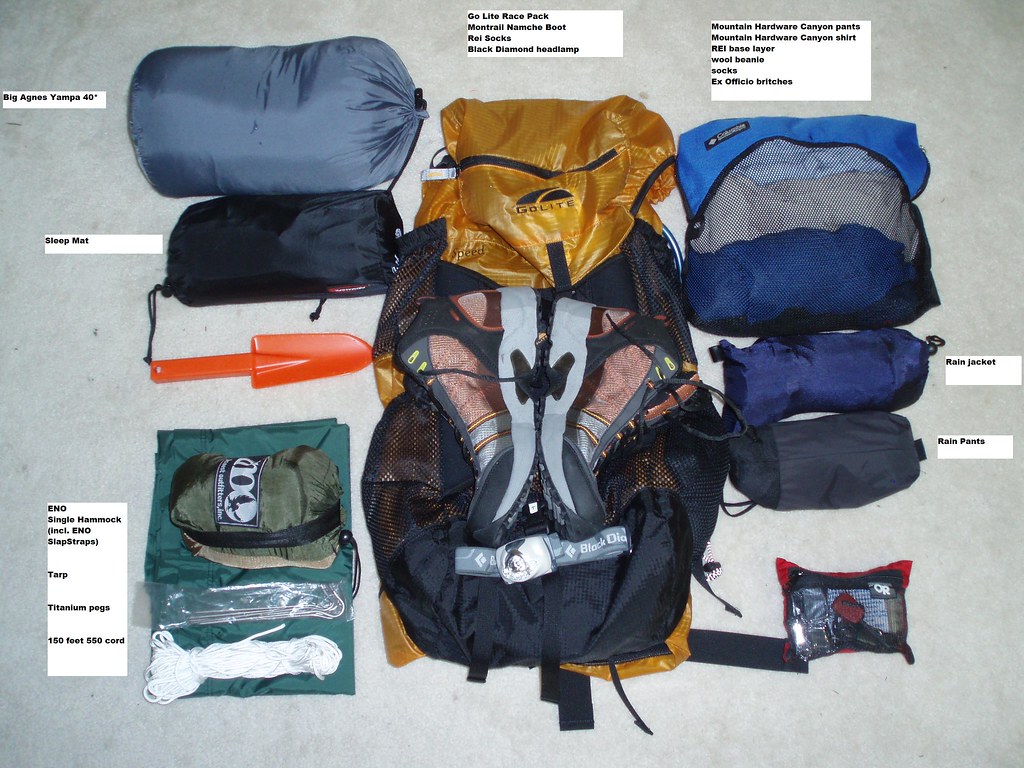
This has given me the opportunity to pack out my camping kit as if I was going out on a much longer trip. Below is my base kit that would last me indefinitely minus food and water. (And of course all the bike and car camping gear I am taking for luxury which would not being going into the backcountry).

In case this doesn't blow out when clicked on. I will describe my gear with hyperlinks. Starting left top to bottom and traveling right top to bottom.

Total base weight, including all the clothes I would be wearing is 16 pounds.

Left Column: Big Agnes Yampa sleeping bag (Outside Gear of The Year 2004), Big Anges sleeping pad (also GOTY 2004). Poop trowel (the campground has bathrooms though) Green 7' x 9' waterproof tarp, ENO single nest hammock with ENO SlapStraps inside (Outside Buyers Guide 2007). Titanium pegs. 150 feet of 550 cord.

Middle Column: Go Lite Race Pack with 3L bladder inside. In the top pouch is a RSK folding knife and Gerber Infinity flashlight, in the pockets is vaseline lip balm, paper, sharpie, wool watch cap, photon freedom micro light clipped to zipper, spf 35, digital camera case, map case with directions to camp ground and Brunton 8096 Adventure Racing compass. On top are Montrail Namche boots (Outside BG 2007) (REI socks inside) and Black Diamond Spot headlamp (Outside BG 2006).

Right Column: Inside clothing bag which is what I will be wearing after the ride- Mountain Hardware Canyon Shirt and Canyon Pants, extra socks, Ex Officio britches, REI base layer, wool beanie, buff, Cool Max base shirt, buff. Next two bags are REI rain jacket, Seirra Design Rain pants.

At the bottom of the right Column is my red EDC (EveryDay Carry) bag. This is with me 24/7 and I use these items on a regular basis, including and replacing items as I use them. It includes an emergency blanket, Photon micro light, generic lighter, Swiss Firesteel fire starter, quart zip lock bag, gallon zip lock bag, button compass, 3 feet of duct tape, signal mirror, whistle, spark lite fire starter with spark lite tinder quick, 4 Gerber Strike Force tinder cubes, list of emergency phone numbers, $50. Calling card. Gerber folding knife.


With these 16 pounds I would have about 11 in the pack and 4 on me in clothes, boots and gear. Its car camping so no water purifier or Nalogene bottles, but I am taking my Naly bottle with Firefly light. A ten day trip would have the same gear above, adding 16-20 pounds of food and stove/gas, remove the hammock system and add another 3 pounds for a tent. Situationally and seasonally dependent I hope the total weight would be less than 40 pounds, closer to 35 making hard choices.

As I get the sleeping shelter set up this weekend I hope to take pictures of how the hammock floats under the tarp. It would be very cool if I can get some video or photos of me starting a fire using the EDC kit and I will first try without the lighters. But hell worst case scenario, which is what I am practicing, I have a flare in the car if I have a real problem. haha.

Tuesday, July 31, 2007

Gear Review: Flashlights or Light & Bright

TBC asked me this question last night:
Oh, and I have been looking for a good LED flashlight. What should I be looking for in terms of brightness, how do I even know? I am looking for something for work to look into crawl spaces, attics and such. I am also wanting something for camping and general use
I felt it only responsible to answer with a full post on flashlights.

First I would like to express my love for headlamps. A previous gear review post lists my favorites and why. Since I also know what TBC does for a living I think that a good headlamp might be a wise investment as the hands-free aspect would benefit his crawling around. But the lights in my gear review are not strong enough for some of his work and if going with a head lamp I would recommend something with a strong battery pack and wattage, such the Princeton Tec Apex Pro with a 3 watt LED and 4 smaller LEDs.

Hands free does have its price though and for about half the money you can invest in decent torch style flashlights.

When discussing brightness there is so many ways to go. I did a small rant in the middle of a post last year on the subject of watt v. lumen v. arbitrary wording. The bottom line is that the brighter the output of light, the faster the batteries will drain. I have very impressive lights that drain $10 in batteries in 20 minutes. Its not a light I would use in an emergency situation or outdoors for camping.

The cheapest and what has been found to be very nice is a replacement LED bulb for the standard bulb 2AA mag-lite flashlights that almost every household has. Walmart sells the LED replacement kit for around $5 and and a bit more for a kit that has a tail switch for on/off. The LED is not blinding level but its a serviceable and cheap fix.

I work on the thought any light is better than no light when you need it and highly recommend the little LED key lights made by Photon or other quality manufacturers. Some of these put out impressive amounts of light for their size.

When moving into the $20 range and above for flashlights you begin working the cost to benefit analysis of size versus power output.

For everyday use and enjoyment, I follow the principle of size and then power. I am much more likely to carry something small and have what I need than something long and bulky that always sits at home.

I mentioned yesterday that I just purchased the Gerber Infinity Ultra. I bought this for my EDC (Everyday Carry). So far this light has been great in that when I needed a light in a hurry it was already on me. This is a service light which will throw a beam about 20 feet but lets be honest most of this work will be from a couple feet away looking for things that have fallen or to maneuver around objects in close proximity to me in a darkened area. The battery output on this 1 LED bulb is around ten hours till 50% brightness. I am sacrificing brightness for size and longevity. Also it takes on AA battery which can be replaced cheaply anywhere.

My favorite set of lights lately and I own just about one of each level is Inova. Inova has created a series of lights from micro to modest size that are beautifully crafted and exceptionally well built. The XO series is not one I have tried yet but based on word of mouth the word is good and at 4 or 5 watts of output is impressive. That is enough to blind some across the room or easily illuminate a wide outdoor area. These lights do not have a tremendous amount of 'spill' off the sides which means its a very focused and tight beam. What Inova did in their marketing was pretty slick. They started packaging their lights so you could turn them on and see how bright they are through an angled mirror. The middle of the round X5 is probably a 2 watt light or around 50 lumens.

The greatest recommendation for a light is one I would buy for someone as a gift. I would say the flashlight I have purchased the most for my friends the last few years is the Inova X5. I personally one two versions of this light in blue and white beams and constantly have to stop myself from buying more. For me they are perfect combination of fit, form and function.

Moving up the cost ladder is the SureFire and Fenix series lights. There is surely more but these are two I am interested in. I own a couple of SureFire lights and the 6P is truly a gentlemen's flashlight. It's spendy at around $60 but with the 125 lumen LED bulb I can completely illuminate the tops of 100 foot trees and hit cars and objects 200 feet away. As I said the burn rate on batteries is pretty high with this light so it is not so much an emergency light as it is something I take with me for formal affairs and get the OMG factor out of people.

I have never used Fenix lights but the reviews have been building and all have been favorable. I wouldn't mind trying one out but they do not seem to be widely sold in the outdoor stores and gun shops I frequent.

Lastly and its not sexy but I highly recommend it, Walmart and Target sell a large battery (6 volt) work lantern for around $6. At Walmart you can find them in the checkout aisles. These are awesome home lights especially if you need something for emergencies or doing some late walking around the neighborhood. They last several hours and for the price can be tossed when done. I have several around the house and in vehicles. If you do not have a true lantern, gas or battery operated, this is the light to have for camping and urban group use.

To get slightly specific I would be remiss I didn't mention another of my latest favorites. The firefly bottle lamp. This nifty little guy replaces the standard lid to a nalogene bottle with a very bright LED waterproof flashlight. For adding just a bit more weight to the bottle you now have a superb lantern that also holds your water. The light also dims so that you can adjust the light down when sharing a tent or all the way up for glowing up a larger area. I generally have one of these lights with me as well since I always carry water with me and I generally enjoy carrying it in my green nalogene bottle.

In summary, to answer TBC I would say, "For work and general purpose start with the Inova X5 and go up from there in price and brightness." I generally recommend everyone have a little microlight from Inova, Photon or Princeton Tec on their keychain or in their purse.


Monday, June 18, 2007

Gear Review-Amphipod Hydration belts


Regardless of time of year or activity it is hard to find me not carrying some sort of container for water, especially outside. In the past I have used Camelback, I have used bottle carriers for the hands and I have used a few different types of water belts. A two bottle system that holds large bike bottles and an single bottle version that also has lots of gel and storage areas sewn into the length of it.

Recently I picked up the 3 bottle system from Amphipod and would like to give my impressions. The Amphipod is a slim line belt that comes stock with anywhere from two to four 8 oz. 'snapflask' bottles, a small accessory pouch for items like gels or radio and stretchy mesh pouch to tightly hold a key or other small item. It has a stretchy feel to it and rides quite comfortably along the hips.

The snapflask is aways something I have looked at with curiosity. They hold about 8 oz., so three flasks would be equivalent to one large bike bottle. Most of the flasks I have seen in the past use a holster to keep the bottle secure. The Amphipod created bottles with channels along the outside that fit into a special locking system on the belt attachment. I felt that the bottles would fall away if I was not careful putting them back, and they have once or twice, but always from my error and not the fault of the company's design.

These bottles are a green color which them easy to recognize in a bag or cupboard. They have a wide open top which makes pouring into and especially cleaning a very simple process. To remove the bottle from the belt attachment, you simply squeeze the sides and the pressure releases the locking bars set into the bottle to hold in place. Its much easier than it sounds.

The belt itself is modular. Regardless if you purchase a two, three or four bottle belt you can add or subtract bottles and their attachments depending on your training. At point of sale I also purchased a small gel flask which holds approximately 4 gel packets and can be added or removed to the belt. Furthermore the belt attachments can be set up to carry your bottles horizontally or vertically. These belt attachments are a plastic holder with the locking bars along the side to fit into and secure the bottle when not in use. The plastic holder is then set onto a soft square of cool max type fabric that allows the whole thing to ride up, down, sideways or placed onto another belt or strap.

The inside of the belt has a soft liner which is nice because I will run without a shirt and on other brands I have finished my training with rubs and scratches to my torso, not so with Amphipod. The stretchy material of the belt along with a generous amount of velcro to fasten it, is a much better concept than the waist pack mentality of buckling then pulling straps tight around your body.

I have used this on runs up to ten miles and with the availability of liquid, see no reason this unit could not support you for much longer runs. My full intent is to use the belt as water support for training and use the gel flask(s) to carry calories on the bike and run. I intend to modify the belt attachment to strap to my tri bike in place of a bento box. In races I would carry the gel flask in some pocket on my uniform.